
"I was young enough, cocky enough, and overconfident enough to just think I should start at the top – so I did" Hugh Stewart

Journal
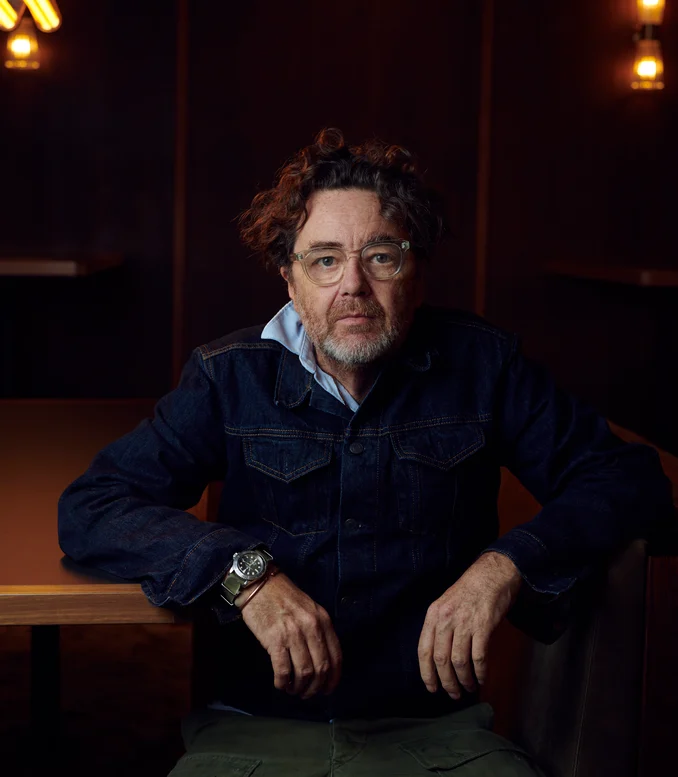
Hugh Stewart | Photograph by Sean Slattery

Catherine Martin on set of Elvis | Photograph by Hugh Stewart
Hugh Stewart beyond the lens
Hugh Stewart has photographed many of the greatest actors and characters of the past 50 years. His story is one of an ambitious, bold, and somewhat dissatisfied youth with a definitive goal: to work for British Vogue – and a naturally relaxed ability to follow his nose on the way there.
From a small farm in South Auckland, New Zealand, to London, New York, and Sydney, Hugh has collaborated with luminaries like Vogue and i-D magazines, Chanel, and Academy Award winning director Baz Luhrmann throughout his career.

Graceland living room, on set of Elvis | Photograph by Hugh Stewart
In 1981 Hugh completed his printing apprenticeship and moved to London, finding himself living in a squat behind Houston Station, Saint Pancreas, with an array of creatives including photographers working for music magazines. “With one of them we built a dark room, and then I had a camera and started shooting over there, I didn’t work but I started taking pictures and I started to really love it,” says Hugh.
Following London came a year in New York and an expired visa which forced him home, but with no interest in farming Hugh quickly moved to Sydney, Australia. “I had all these photographs, so I made a portfolio. I was young enough, cocky enough, and overconfident enough to just think I should start at the top – so I did, I went to see Vogue and they actually gave me a job."
With ambitions beyond 1980s Sydney, Hugh spent his early career working between London and New York, developing his photographic style firstly in commercial fashion and then in portraiture. Although currently embracing the bright light and hard shadows of Australia’s Northern Territory, his expansive body of work has a consistently moody atmosphere, capturing emotions in his photographs which are by no means sad, instead conveying a decidedly grungy aesthetic. “It’s growing up in New Zealand, that’s because I grew up in the rain! … My family are originally from the Isle of Skye (Scotland), and I have been there a lot, but I don’t think I’ve ever been there when it’s not raining. There’s a real beauty in that that I love … it’s funny because I live in a bright, sunny, frivolous city you know, Sydney, so I do like that too. But in terms of my photographs, I love that kind of texture and depth and the moodiness that you get with that.”
Hugh met Baz Luhrmann and Catherine Martin nearly 30 years ago, when on the back of the successful release of the 1992 Australian classic Strictly Ballroom the creative couple envisaged a modern interpretation of Shakespeare’s Romeo and Juliet. To raise the capital required Baz and Catherine flew the relatively unknown American actors Leonardo di Caprio (Romeo) and Natalie Portman (a possible Juliet) to Australia, “they wanted to photograph the workshop and film it so that they could cut something together in the style that the film would be made in and test costumes and looks.”
The workshop was captured on Hugh’s Super 8 camera then cut together by Baz, resulting in the six-minute treatment used to convince the studio to finance the film. “Out of that shoot came all the photographs. They’d already made decisions about the costumes, what’s now become quite famous – the Hawaiian shirt that Leo was wearing. So those pictures became synonymous with the film I suppose.”

Leonardo di Caprio in Romeo and Juliet | Photograph by Hugh Stewart
Then came creative projects including Moulin Rouge!, two Chanel No. 5 perfume campaigns, The Great Gatsby, The Get Down series on Netflix, and many more opportunities in between. “They’re incredibly loyal and I suppose I must’ve done a reasonable job …. I’ve been very lucky. I’ve had a really long relationship with them, which eventually led to me doing Elvis.”
The Elvis biopic was filmed amidst the pandemic and as such, it was the first time that Hugh could commit himself to three to six months on set. It was a combination of the government restrictions in workplaces and the technological advancements of digital photography, accompanied by the directorial vision and trust from Baz which led to Hugh joining the production full time. “This is what I love about those guys ... his whole thing to me was just come and take pictures, your perspective on the film.”
Like much of Hugh’s career, his method of set photography is far from traditional. Rather than recording a still version of each scene, Hugh constructed a studio and a self-declared ponzi scheme to run alongside, amalgamating the photography budgets.
“I ended up shooting on pretty much the whole thing. I think I ended up shooting 93,000 frames, which we’ve now edited down to about 1500 which will be the final body of work that ends up being associated with the film. But it was interesting, and it was a good way of proving that there’s a different way of approaching on set photography.”
The Elvis experience has not only altered Hugh’s attitude towards on set photography but influenced the way he works, choosing to visit the set on key days to capture the process of making the film. “I might be on set and the actors’ just sitting around and if they’re agreeable I’ll take them off set and take a picture of them somewhere relevant to the film but not necessarily what the film is shooting. Which I think is more interesting, it’s better for the photographer and I think it also provides the film company with a lot more collateral that they can roll out when they’re trying to promote the film … The trailer and the marketing around the film is equally important and that’s what Baz and Catherine absolutely understand.”
Hugh has made a career out of working with actors, both as a director and a photographer. “You’ve got to be respectful of how actors work, you can’t be getting in the road ... It takes a lot for them to get in character and stay in character. Sometimes they stay in character between takes, sometimes they’ll stay in character all day. You’ve got to have a degree of intelligence … You’ve got to kind of understand the process and be sensitive and empathetic to how people work.”

Catherine Martin on set of Elvis | Photograph by Hugh Stewart
Portraiture is an artform unlike any other. Capturing the personality, status, and mood of an individual at a particular moment in time. Analysed by historians, manipulated by politicians, and over the past 100 years – especially in the last decade – democratized like no other. As much as the characters in films are invented or reimagined, when they sit for Hugh in his studio they become people in their own right. So, what distinguishes a person from a character? Very little it seems.
“It’s a little bit like photographing two different people. Because you’re still looking for the same thing, you’re still looking for an authentic photograph that doesn’t feel forced and feels that it truly represents something about them … Like when Austin was playing Elvis, he was basically Elvis for a year. He spoke in his voice – everything. And if he came on to my little studio and he was Austin, he didn’t look like Elvis because of the way he held his face muscles, everything changed the minute he stayed in character, but he looked the same, he was wearing costume and everything. But then when we really looked at the photographs afterwards it was like, he looks like Austin Butler, he doesn’t look like Elvis.”
Hugh’s take on set photography resulted in his on-screen debut with the opportunity to capture Elvis on stage. In 1956 Alfred Wertheimer was employed by RCA Records to photograph a 21-year-old musician he’d never heard of on CBS’s Stage Show. Over the next two years he spent ten days with Elvis, capturing over 2,500 photographs of the months before Elvis reached superstardom. Of particular interest to the film are a series of infamous black and white concert photographs, mid-performance and radiating energy Elvis is up on his toes. In the original recording of the concert Wertheimer can be seen shooting from the side of stage, poised between two worlds: the entertainer and the audience – a crack Hugh slipped through with ease.
We had talked about making sure that we got that photograph because that’s one of the scenes in the film, that concert. It was at the stadium, and I was walking up set one day and Baz was like, ‘We need to get that picture, what do you reckon? … You can play Wertheimer’ … It was ridiculous really because I’m like 60 and Wertheimer is 23 … I had to go and spend three days, every morning in hair and makeup and costume and all the rest of it getting transformed into a 23-year-old photographer. But it meant that when they were shooting, I could be on the stage, and when the cameras weren’t on me, I’d whip my camera out and photograph them and we got extraordinary pictures that are kind of a modern interpretation of exactly what Wertheimer did.”
Hugh has photographed an impressive list of celebrities, but how would he photograph the enduring cultural icon that is Elvis Presley? “There’s something I love about taking people’s portraits and just rocking up and figuring it out on the day. So, I would be quite happy to just get into Graceland – and I’m pretty good at getting people to do stuff – I reckon I could have probably talked him into taking me upstairs to the part of Graceland which is completely off limits and photograph him sitting up there.”
Nestled into an opulent array of pink and green velvets and maximalist animal prints sits the denim-on-denim clad Catherine Martin. We’ve found a mid-photoshoot moment to pause with the Academy Award winning costume and set designer to find out what inspires her at work and in her home.
